Aum Namah Shivaya!

If my writing resonates with you, consider ordering my book on Amazon.

👉 The Magnificent Shiva: Why there is no one like Lord Shiva?

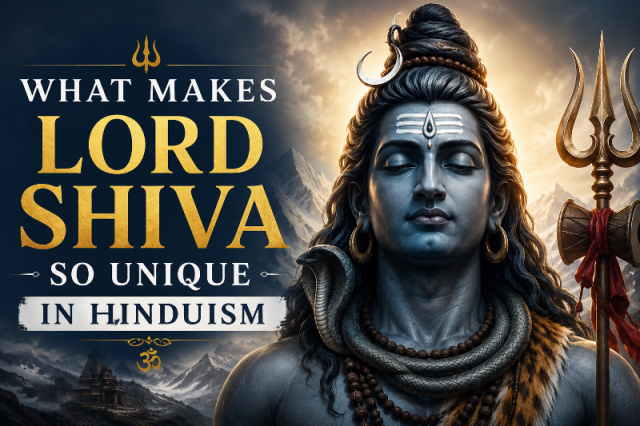
What makes Lord Shiva so unique in Hinduism

What makes Lord Shiva so unique in Hinduism

Note: Image created using AI-generated illustration.

Introduction

Many seekers are curious about what makes Lord Shiva so unique in Hinduism. They often wonder about his role as the supreme consciousness in Shaivism, but there is much more to discover about him.

In fact, something is captivating about Lord Shiva that draws people toward him. To all those friends, I would like to introduce Lord Shiva as the source of our existence—acting as the creator, preserver, and destroyer. He is truly unique in many ways. In this article, I will explore Hindu philosophy in greater detail and explain why Lord Shiva holds a special place in Hinduism.

The Vedas are the world’s most ancient sacred scriptures and are regarded as the language of Lord Shiva. He communicates through vibrations and frequencies. What is particularly interesting about Lord Shiva is his neutrality; he does not lean toward any extreme or specific side. That is why Lord Shiva is the common Lord of Deities and Asuras.

He manifested himself as the first Yogi, known as Adiyogi, so that his disciples and the new generation of yogis could use his teachings from the Vedas to create a more connected and conscious world.

Subscribe to our free newsletter, and unlock the best spiritual and devotional articles.

Lord Shiva’s Duality: The Balance of Creation and Destruction


It is widely accepted that every human consists of two aspects: light and darkness, or, in simpler terms, goodness and evil. When this balance is disrupted, it leads to chaos and problems. Lord Shiva teaches us to maintain that balance. A prime example of this is his Ardhanarishwara form, which is half Lord Shiva and half goddess Parvati, his consort. Parvati represents the goddess of energy. In the form of Ardhanarishwara, Shiva conveys the message that the feminine and masculine aspects are equivalent to each other—neither is superior.

When a person values both aspects, the balance is sustained, allowing them to live a harmonious life. However, when one aspect becomes dominant over the other, life can become chaotic and unharmonious. This understanding is why the devotees of Lord Shiva cherish both aspects of existence. They embrace the concept of duality, recognizing that if there is a sunrise, there will also be a sunset. Just as there is birth, there is also death. The key is learning how to navigate life during our journey. An emotionally balanced life adheres to the idea of vairagya (detachment), meaning one should not become overly excited by achieving something good or overly depressed by losing something. This balance is essential for a fulfilling existence.

One important lesson we can learn from Lord Shiva is the value of self-control and maintaining calm in all situations. Lord Shiva possesses immense power and is invincible; he can cause great chaos when disturbed. This fearsome aspect of him is referred to as Rudra. However, Lord Shiva knows how to manage this fierce nature and rarely unleashes his anger in his Rudra form. Instead, he is widely recognized as the most compassionate deity, known as Bholenath. This name signifies his simplicity, innocence, and caring nature. The name Bholenath is also close to my heart.

In Sanatan Dharma, Lord Shiva is revered as the mightiest of all. Everything begins with him and, at the end, dissolves into him. For the welfare and smooth operation of the cosmos, Shiva manifested his various forms. The name “Shiva” itself signifies auspiciousness. Those who chant either Shiva’s name or his mantra are liberated from all ailments and find clarity and inner peace. Shiva devotees are free from all eight types of poverty. Let me explain the eight types of poverty that are eliminated by chanting the name of Lord Shiva.

The Eight Types of Poverty

  1. Absolute poverty: It refers to a severe deprivation of basic human needs, where a person lacks food, water, and shelter.
  2. Circumstantial poverty: It is the state in which a person faces an unexpected crisis, loss, or disaster in life.
  3. Relative poverty: It occurs when a person earns less than a respectable income and lives below the average standard, unable to fulfill societal responsibilities.
  4. Generational poverty: It is the kind of Karmic deprivation or a curse whose burden is passed to the next generation.
  5. Agrarian poverty: A form of poverty in which a person lacks the infrastructure, tools, and resources to overcome their challenges.
  6. Bodily and mental poverty: It refers to a condition where an individual suffers from both mental and physical disorders. This may manifest as a lack of essential life skills and education, making it difficult for them to maintain a stable lifestyle. As a result, they often endure a chaotic, painful existence. In some instances, individuals may experience both forms of poverty simultaneously.
  7. Emotional poverty: It is a state in which a person has no trustworthy companions in their life. They live an isolated existence, lacking the emotions and affection of others. This is one of the most painful forms of poverty, as having no one to share experiences and emotions with can be incredibly distressing. Life becomes a burden; happiness and joy disappear, and an intense hush and darkness take over you.
  8. Cultural and spiritual poverty: Cultural and spiritual poverty describes a condition in which a person lacks social values and a sense of shared heritage. Individuals in this state are often disconnected from their inner selves, continuously pursuing illusions—commonly referred to as Maya. As a consequence, they are unlikely to achieve inner awareness or true understanding. They may feel empty inside, as those who do not resonate with their social values or deeper truths often go unappreciated. Ultimately, these individuals may realize that others have taken advantage of them for personal gain because of their disconnection from their own truth; however, by then, it may be too late for them to feel regret.

Lord Shiva empowers those who embrace a dharmic life and dedicate themselves to the service of humanity, lifting them from all eight forms of poverty.

The primal Lord in Hinduism


He is the primal Lord in Sanatan Dharma and is revered by a large section of humanity. Many aspects make Lord Shiva truly unique in the entire Hindu pantheon. Shiva exemplifies selflessness, strength, and knowledge, never seeking anything in return. Instead, he generously offers his advantages to others with open hands. During the churning of the cosmic ocean, while others rejected the poisonous Halahal and prayed to Lord Shiva for protection from its harmful effects, Lord Shiva chose to drink the cosmic poison himself in order to save the universe. Afterward, he distributed the elixir to the deities.

In contrast to other deities who live luxurious lives adorned in golden robes and jewelry, Lord Shiva wraps himself in a tiger skin and smears ashes on his body. This reflects his message that the world, which many take for granted, is not the ultimate reality. Ultimately, everything will be destroyed and merged back into him. We need to enhance our awareness and broaden our perspectives. By doing so, we can better understand the world around us and make more informed decisions.

Lord Shiva has neither a beginning nor an end, as He is free from all limitations and transcends the laws of the cosmos and physics. He exists in every tiny particle as well as in every massive celestial body. Indeed, He represents the dark energy and dark matter that scientists and researchers are seeking in the universe. His cosmic dance symbolizes the dance of energy. The Natraj idol of Lord Shiva installed at CERN serves as a testament to this connection.

The truth is that Lord Shiva is beyond human description and is worshipped all over the world. It doesn’t matter whether you are a Hindu or not; Lord Shiva is relevant to all rational beings. He transcends social and religious beliefs, symbolizing inner peace, clarity, enlightenment, courage, and divine knowledge.

Why millions of devotees are drawn to Shiva.


Before I connected with Lord Shiva, I didn’t fully understand His significance. However, as life unfolded, I came to realize that when you reach a certain level of maturity, you suddenly recognize the qualities of Lord Shiva that begin to attract you to Him. After that, you start to appreciate life more deeply. The Bhakti (devotion) of Lord Shiva makes you a compassionate and humble human being. You start to see positivity in everything. It has been found that those who study Lord Shiva often experience a transformation in their lives, gaining a clearer understanding of existence and finding beauty in their everyday experiences.

Let me explain what I mean by this. People who understand the reality of the world often feel a connection with Lord Shiva because He embodies authenticity. Lord Shiva’s simplicity and compassionate nature are what draw people towards him. Shiva is the Lord of consciousness, strength, knowledge, and clarity. He frees his devotees from all darkness and brings them to light by providing them hope, joy, and inner strength. You can place your complete trust in Shiva, who is also revered as the great God Mahadev.

The Divine Family of Lord Shiva


Lord Shiva has never deceived anyone and has always kept his promises. There are no illusions in his lifestyle. He lives a simple life on Mount Kailash with his family. Although the entire world is considered his family, as he is the ultimate source of everything, Lord Shiva’s immediate family includes Goddess Parvati, his loving consort, their two sons, Lord Ganesh and Lord Kartikeya, and their daughter, Ashok Sundari. However, his family also extends to his devotees and his followers, known as Shiva Ganas, which include animals, spirits, and all celestial beings who have sought refuge in him. As a human, I also see myself as part of his family, standing at the end of the line, to catch a glimpse of him and serve him unconditionally.

I feel connected to Lord Shiva.

I have a heartfelt emotional relationship with Lord Shiva, as I see Him as my father and a true guardian who held my hand during the darkest phase of my life. Lord Shiva was the first one to listen to my spoken words and truly feel my pain. He came to my rescue and removed all the fear and darkness from my heart. If I am writing this article, it is because of Lord Shiva, who encouraged me to embrace writing and has made my life beautiful in every aspect.

Many people often wonder who has seen God. I can confidently say that He exists and hears everything you express from your genuine emotions. There is no need to fear Him, as He is compassionate and simple, desiring nothing more than for His children to follow the path of righteousness, commonly known as Dharma. For me, His name is Lord Shiva, as I have experienced Him in that form and found Him to be extremely calm and compassionate. He has helped me explore my inner self and choose my path. It is not about religion; it is about trust and devotion.

The most fascinating aspect of Lord Shiva is that he does not reside in heaven; instead, he lives on Mount Kailash on Earth, closer to his devotees. However, the true Kailash is invisible and inaccessible to us because it is protected by nature and divine beings. This is why no one has ever conquered the peak of Kailash, even though it is not the highest mountain in the world. Something or someone prevents ordinary people from reaching it because they do not want Lord Shiva disturbed.

Shiva frequently meditates on Mount Kailash to oversee the cosmos, as he is responsible for everything that occurs within it. In his highest form, he is shapeless and without attributes; however, for the welfare of the cosmos, he manifested himself so that others could perceive his existence and feel a connection to him.

Conclusion

According to seers and devotees, Lord Shiva is one of the greatest givers in the world. He can be easily pleased with just an offering of a bilva leaf. Most importantly, there are no strict rules for worshiping him, as he is free from all limitations and desires only genuine faith from his devotees.

Before concluding, I want to emphasize that there is much to learn about Lord Shiva. Understanding Lord Shiva enables us to explore our own reality and discover who we are and why we exist.

Running a wellness brand, coaching business, or spiritual platform, and need content like this? Work with me

Friends, your every share motivates me to write more spiritual content for all the readers and helps the search engine algorithm reach the right audience. 

We are grateful for all your kindness and support. 

Or you can also follow us on Facebook Author page

Aum Namah Shivaya

 🚀 Subscribe to my weekly newsletter for behind-the-scenes, article updates and insights.

Santosh Gairola


 Support My Work

Writing about Lord Shiva and Sanatan Dharma is a deeply personal journey for me.
Each article comes from study, reflection, and sincere effort to share something meaningful.

If this article helped you deepen your understanding of Lord Shiva and Sanatan Dharma, you can support my writing through a voluntary donation. Your support helps me continue creating free content for readers around the world. 

🇺🇸 My Amazon book Store USA 

🇮🇳 My Amazon book Store INDIA

My articles will always remain free for everyone. Support is completely optional.

My UPI QR Code 🇮🇳

Santosh Gairola QR

My UPI ID  🇮🇳

  • Santosh.8317-9@waaxis
Scroll to Top
Share via
Copy link